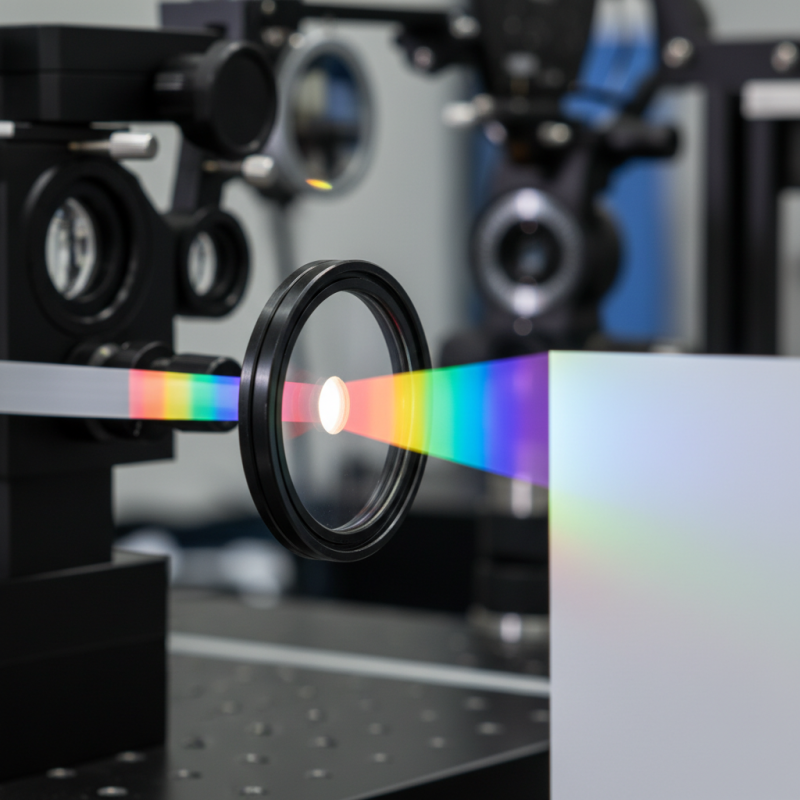
What is an Interference Filter and How Does it Work?
Interference Filters are essential tools in optics. They selectively transmit specific wavelengths of light while reflecting others. This unique ability makes them invaluable in various applications, from photography to scientific research.
These filters rely on the principle of optical interference. The thin layers within the filter create constructive and destructive interference patterns. As light passes through, only certain wavelengths are allowed to pass. This results in enhanced color accuracy and precision in measurements.
The design of interference filters requires expertise in optics and materials science. Manufacturers must balance factors like thickness, material type, and angle of incidence. Miscalculations can lead to unwanted color shifts or reduced efficiency. Understanding these nuances is critical for achieving reliability in practical uses.
What is an Interference Filter?
An interference filter is a sophisticated optical device used to selectively transmit light of specific wavelengths while reflecting others. This selective transmission is achieved through thin layers of materials. These layers create constructive and destructive interference patterns. When light strikes the filter, it interacts with these layers, allowing only certain wavelengths to pass through. The result is a vibrant color spectrum that is precisely tuned to desired applications.
Interference filters are widely used in various fields. For instance, they play a critical role in photography and scientific research. Scientists utilize these filters to isolate specific wavelengths in experiments, which helps improve the accuracy of measurements. However, designing effective interference filters is tricky. The number of layers, material choice, and thickness all influence their performance. A poorly designed filter could lead to unexpected results or loss of detail.
Despite their effectiveness, there are limitations to consider. The angle of incidence can affect transmission, leading to variations in color perception. Users must reflect on these factors. An understanding of the application context is essential for optimal results. Experimentation with different configurations may be necessary to achieve the best outcome. This trial-and-error approach can be both frustrating and enlightening.
Principles of Interference Filter Operation
Interference filters are optical devices used to selectively transmit certain wavelengths of light. They operate on the principle of interference, which arises from the interaction of light waves. When light encounters a thin film, such as those found in interference filters, some light waves reflect off the film’s surfaces while others pass through. These waves can combine in various ways, leading to constructive or destructive interference.
The construction of an interference filter typically involves multiple layers of differing refractive indices. This multilayer design allows for precise control over which wavelengths are transmitted. For example, a filter can be engineered to allow blue light to pass while blocking red light. Such specificity is vital in applications ranging from scientific research to photography. Understanding the precise layer thickness is crucial. A slight variation can change performance dramatically. Calculating the optimal design requires a blend of math and practical testing.
However, making interference filters isn't always straightforward. Variations in material properties can affect results. Environmental conditions during application also play a role. These factors remind us of the complexities in optical engineering. Some filters may not perform as expected, necessitating adjustments and recalibrations. This iterative process can be both frustrating and enlightening, highlighting the importance of attention to detail in optical design.
Types of Interference Filters and Their Applications
Interference filters are crucial in various applications. They selectively transmit specific wavelengths of light. This capability is essential in fields such as photography, microscopy, and telecommunications.
One common type is the bandpass filter. It allows a certain range of wavelengths while blocking others. This type is often used in fluorescence microscopy. It helps in viewing specific dyes within a sample. Another type is the notch filter. It eliminates specific wavelengths, making it useful in laser applications. In some situations, using the wrong filter can lead to poor image quality or incorrect data.
Polychromatic interference filters are also popular. They manipulate light in different ways. Their applications extend to scientific research and industrial processes. They can be complex to design, requiring careful consideration of materials. Despite advancements, manufacturers may face challenges in achieving precise cut-off wavelengths. These issues highlight the importance of expertise in filter design and application in various settings.
Factors Affecting the Performance of Interference Filters
Interference filters are essential optical components widely used in various applications, including spectroscopy, microscopy, and photography. Performance can vary based on several factors. One critical element is the filter material. Common materials include glass and plastics, each with unique optical properties. Glass filters typically offer better performance in terms of thermal stability and durability compared to their plastic counterparts.
Another significant factor is the wavelength range of the filter. Different filters are designed to isolate specific wavelengths, impacting their efficiency. According to industry reports, filters that operate in the visible spectrum have more stringent requirements for coating uniformity. Variations in coating thickness can lead to significant changes in transmission performance. These minor discrepancies can be crucial in precision applications.
Environmental conditions can also affect filter performance. Temperature fluctuations may lead to refractive index changes, altering the filter's effectiveness. Humidity can impact coating integrity over time, suggesting the need for regular maintenance in certain settings. The durability rating of a filter plays a critical role in its long-term reliability. Regular assessments of the filter's condition can prevent performance degradation, ensuring optimal functionality when it matters most.
Performance Factors of Interference Filters
This chart illustrates the impact of various factors on the performance of interference filters. The factors considered include wavelength, incident angle, thickness, and material index, highlighting their relative influence on filter effectiveness.
Applications in Modern Technology and Research
Interference filters are essential tools in modern technology and research. They help scientists and engineers separate specific wavelengths of light. This capability is crucial in applications such as spectroscopy. In spectroscopy, interference filters enable precise measurements of materials' properties. Researchers can analyze complex compounds with high accuracy, leading to advancements in various fields.
Another important application is in optical communication systems. Interference filters enhance signal clarity by isolating specific wavelengths. This function improves data transmission rates. Engineers often rely on these filters to design more efficient systems. They contribute significantly to the performance of fiber optics. The impact on telecommunications is profound.
In medical diagnostics, these filters are also key. They assist in imaging techniques like fluorescence microscopy. Such methods rely on isolating light to reveal details of biological samples. The precision of interference filters can enhance disease detection and research outcomes. However, challenges persist. Designing filters for diverse applications requires ongoing innovation. Balancing performance with cost can be difficult. This area of research constantly evolves in pursuit of better solutions.
What is an Interference Filter and How Does it Work? - Applications in Modern Technology and Research
| Application | Description | Technology Used | Benefits |
| Photography | Used to enhance color contrast and saturation in images | Multilayer coatings | Improved image quality |
| Astronomy | Isolates specific wavelengths from celestial objects for analysis | Dielectric interference filters | Enhanced spectral data precision |
| Telecommunications | Filters specific wavelengths to separate data channels | Optical interference filters | Increased bandwidth and data integrity |
| Biomedical Applications | Used in fluorescence microscopy to isolate emitted light | Bandpass filters | Improved imaging of biological samples |
| Environmental Monitoring | Used to analyze pollutants by isolating specific wavelengths | Optical sensors with interference filters | Accurate chemical detection |