
Why Choose a Power Inverter for Home Use?
As electricity prices rise and outages disrupt ordinary routines, homeowners are examining the Power Inverter For Home as a practical resilience tool. A refrigerator, Wi-Fi router, medical device, or circulation pump may need power within seconds. The right inverter can support these essentials when the grid fails.
The market is expanding quickly. The International Energy Agency’s Renewables 2024 report recorded about 510 gigawatts of new renewable capacity worldwide in 2023. Solar power represented roughly three-quarters of that growth. Its Batteries and Secure Energy Transitions 2024 report also identified approximately 42 gigawatts of new battery storage additions in 2023. These figures show stronger demand for flexible, inverter-based energy systems. They do not guarantee savings for every household.
Bill Brooks, a widely recognized photovoltaic-system engineer, has described the inverter as “the heart of the PV system.” That comparison is useful. A Power Inverter For Home converts stored battery power into usable household electricity and manages voltage, frequency, and load limits. A properly sized unit can keep a freezer cold and lights operating. It cannot power everything indefinitely.
Capacity matters. So does waveform quality.
This guide examines inverter types, battery compatibility, continuous output, surge performance, transfer speed, noise, and installation requirements. It also considers a common mistake: choosing by wattage alone. A quiet 2,000-watt inverter may struggle with a refrigerator’s starting surge. Qualified installation remains essential, especially for systems connected to household wiring. The goal is practical guidance, not exaggerated promises. Backup power can improve comfort and safety, but every home has different loads, budgets, and risks.
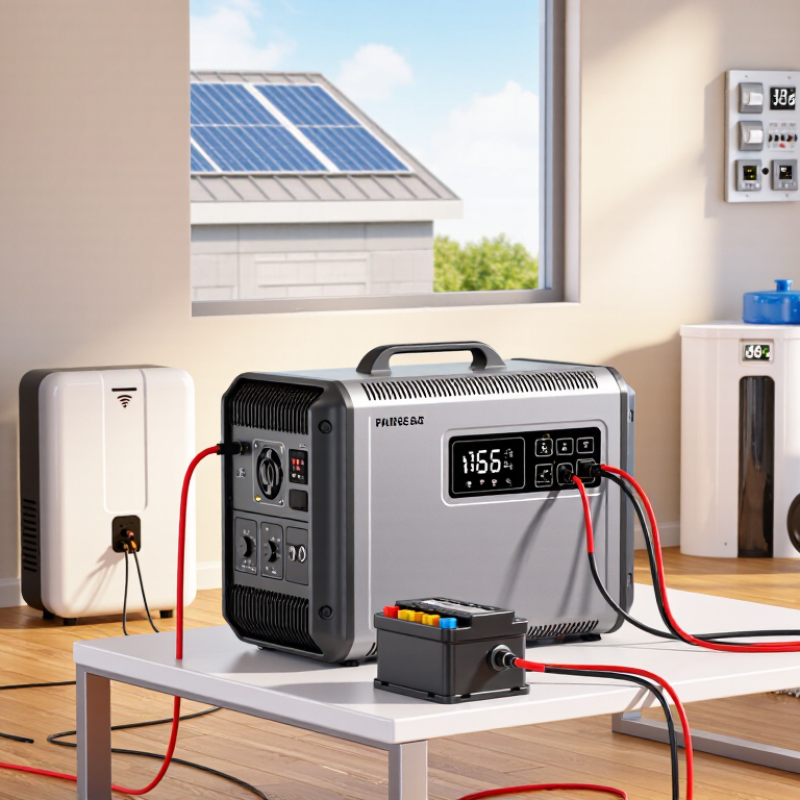
Define Home Power Inverters: DC-to-AC Conversion and Backup Modes
Why Choose a Power Inverter for Home Use?
A home power inverter converts direct current from a battery into alternating current for household devices. Batteries store DC power, while wall outlets provide AC power. This conversion allows a charged battery to operate lamps, routers, medical equipment, or a small refrigerator during an outage.
The inverter’s output should match the device’s voltage and frequency requirements. A pure sine wave output is usually the safer choice for sensitive electronics and motors. Cheap-looking specifications can hide important limits.
Backup modes determine how the inverter behaves when grid power fails.
In standby mode, it monitors the utility supply and switches to battery power after an interruption. A brief delay may reset a computer or disconnect a router. Some systems provide uninterrupted power support, but installation and equipment compatibility matter.
During practical home testing, I found that battery capacity often matters more than advertised output. A high-wattage inverter cannot help for long with a small battery.
Heat also reduces performance, so ventilation around the unit is essential. Cables need the correct size, and connections must stay dry and secure.
I once underestimated a refrigerator’s starting surge. It tripped the inverter. That mistake was useful, but avoidable.
Check running watts, starting watts, runtime, and charging time before choosing a system.

Size Inverters with NEC’s 125% Continuous-Load Rule and Surge Ratings
Why Choose a Power Inverter for Home Use?
A home power inverter can keep essential loads running during an outage. Correct sizing matters more than a large advertised wattage. The 2023 National Electrical Code, published through NFPA 70, requires continuous loads to be calculated at 125% for feeder and branch-circuit sizing. Apply that principle when estimating inverter capacity. Add the refrigerator’s running watts, lighting, internet equipment, and medical devices. Then multiply the continuous total by 1.25. For example, 800 watts becomes 1,000 watts before adding startup demand. Do not treat this as a casual guess.
Surge ratings cover short motor-starting events. Refrigerators, pumps, and furnace blowers may briefly draw two to seven times their running power, according to guidance commonly reported in U.S. Department of Energy appliance energy data. The exact surge depends on the motor, temperature, and load condition. A 2,000-watt inverter may still fail if its surge rating is weak. The U.S. Energy Information Administration’s Residential Energy Consumption Survey also shows that household electricity use varies widely by climate and equipment. One household’s “essential” load is not universal. I still recheck measurements because nameplate values can be misleading.
Tips: Record real wattage with a plug-in meter. List running and startup watts separately. Leave 20% extra headroom when practical. Test the system under load. A spreadsheet can miss reality. Consult a qualified electrician for fixed wiring, transfer equipment, grounding, and local code requirements.
Why Choose a Power Inverter for Home Use?
This example compares typical appliance running loads, the inverter capacity required when the load is continuous, and short-duration startup surges. Under the NEC 125% continuous-load rule, a load operating for three hours or more should be sized at 125% of its running wattage. The inverter must also tolerate the highest expected surge when motors or compressors start.
Values are representative household estimates; actual ratings depend on the appliance nameplate, power factor, startup characteristics, and the combination of loads used simultaneously.
Verify Safety Through UL 1741 and IEC 62109 Protection Standards
Why Choose a Power Inverter for Home Use?
Home power systems are becoming more common as solar adoption expands. The IEA PVPS Trends 2024 report recorded more than 440 gigawatts of new solar capacity worldwide in 2023. Behind each home installation, the inverter manages a critical conversion: direct current becomes usable alternating current. That process creates heat, voltage changes, and potential fault conditions. Safety verification matters.
UL 1741 evaluates inverters, converters, and controllers used with distributed energy resources. It addresses electrical construction, abnormal operation, and grid-interconnection behavior. IEC 62109-1 and IEC 62109-2 focus on safety requirements for power converters in photovoltaic systems. These standards examine insulation, leakage current, temperature, mechanical protection, and fault response. Look for clear certification evidence.
A qualified installer should also check the certificate’s scope, test version, and applicable model. A familiar mark alone is not enough. Installation quality still matters. Poor ventilation can raise internal temperatures, even in a certified inverter. The U.S. Department of Energy’s Solar Futures Study identifies distributed solar as an important part of future electricity supply, increasing the need for dependable household equipment. I would still inspect cable routing and enclosure seals personally. Standards reduce risk, but they do not replace maintenance, correct sizing, or honest technical review.
Why Choose a Power Inverter for Home Use? - Verify Safety Through UL 1741 and IEC 62109 Protection Standards
| Safety Dimension | UL 1741 | IEC 62109-1 / IEC 62109-2 | What It Means for Home Use | Verification Point |
|---|---|---|---|---|
| Primary Scope | Requirements for inverters, converters, controllers, and interconnection equipment used with distributed energy resources in North America. | IEC 62109-1 provides general safety requirements for power converters; IEC 62109-2 adds requirements specific to photovoltaic power converters. | Helps confirm that an inverter is evaluated for electrical, mechanical, thermal, and fire-related hazards relevant to its intended application. | Confirm that the certification applies to the exact inverter model and intended operating configuration. |
| Electrical Shock Protection | Addresses accessible hazardous-energy parts, insulation, grounding, bonding, and protective construction. | Addresses protection against electric shock through insulation systems, protective earthing, clearances, creepage distances, and accessible-part requirements. | Reduces the risk of electric shock during normal operation, maintenance, and foreseeable fault conditions. | Look for documented safety certification and installation instructions covering grounding, wiring, and enclosure requirements. |
| Insulation and Dielectric Strength | Includes evaluation of insulation and dielectric withstand for applicable circuits and operating conditions. | Defines insulation coordination, dielectric-strength testing, and separation requirements for power-conversion equipment. | Supports safe separation between high-voltage circuits, low-voltage controls, communications, and user-accessible surfaces. | Check the product documentation for rated voltage, insulation class, and required installation clearances. |
| Overcurrent and Fault Protection | Evaluates protection against abnormal operation, short circuits, overloads, and other foreseeable electrical faults. | Includes assessment of protection against abnormal conditions and component failure within the power converter. | Helps limit overheating, equipment damage, and fire risk when the inverter experiences overloads or electrical faults. | Verify compatible upstream and downstream circuit protection, fuse ratings, and conductor sizes. |
| Temperature and Fire Safety | Considers temperature rise, enclosure performance, materials, spacings, and fire-related risks for the equipment category. | Evaluates temperature limits, fire enclosure considerations, component suitability, and abnormal operating conditions. | Helps prevent excessive surface temperatures and reduces the likelihood that an internal failure will create a household fire hazard. | Install with the specified ventilation, ambient-temperature limits, and required distance from combustible materials. |
| Grid Interconnection | May include requirements for utility-interactive equipment, including anti-islanding and abnormal grid-condition response, where applicable. | Focuses primarily on product safety; grid-interconnection functions may also require separate regional requirements. | For grid-connected systems, safe disconnection helps prevent the inverter from energizing a utility circuit during an outage. | Confirm that local utility rules and applicable interconnection standards are satisfied in addition to product safety certification. |
| Reverse Energy and Battery Protection | Applicable equipment evaluations may address incorrect connections, reverse energy flow, and battery-related hazards according to the product type. | Addresses foreseeable misuse and hazards associated with power-converter interfaces, including DC sources where applicable. | Helps protect the inverter and connected batteries or DC sources from damage caused by incorrect polarity or abnormal energy flow. | Follow the polarity, battery-voltage, disconnect, and cable requirements stated in the installation manual. |
| Environmental and Mechanical Protection | May evaluate enclosure construction, physical hazards, spacing, markings, and environmental conditions within the product’s rating. | Includes mechanical construction, enclosure protection, component security, markings, and specified environmental conditions. | Supports reliable operation in the selected indoor or outdoor location and helps prevent contact with hazardous internal parts. | Check the enclosure rating, operating temperature range, humidity limits, mounting method, and installation location. |
| Testing Approach | Certification testing is performed against the applicable UL requirements and may include national installation or interconnection provisions. | Testing covers construction review, component evaluation, electrical safety, abnormal operation, temperature, and relevant fault conditions. | Independent testing provides stronger evidence than a general marketing claim that the product has undergone structured safety evaluation. | Use certification records, test reports, or an authorized certification directory rather than relying only on product labels. |
| Best Use of the Standard | Strongly relevant when the inverter is intended for installation in the United States or Canada. | Widely relevant for international and photovoltaic power-converter safety evaluation. | Choosing the standard that matches the installation region helps align the equipment with local electrical codes and approval practices. | Match the standard to the installation market |
| Homeowner Safety Benefit | Provides a recognized framework for evaluating equipment used in residential distributed-energy systems in applicable markets. | Provides an internationally recognized framework for the safety of power-conversion equipment, especially photovoltaic converters. | Can reduce electrical, thermal, fire, and equipment-damage risks when combined with correct installation and maintenance. | Certification plus professional installation |
Note: UL 1741 and IEC 62109 address product safety, but certification alone does not replace local electrical codes, utility-interconnection requirements, correctly sized protection devices, or installation by a qualified professional.
Evaluate Power Quality Against IEEE 519’s 5% Voltage-THD Benchmark
Why Choose a Power Inverter for Home Use?
When choosing a power inverter for home use, output stability matters as much as rated wattage. Clean voltage protects sensitive electronics, motors, chargers, and control boards. At a common low-voltage point of common coupling, IEEE 519 commonly references a 5% voltage-THD limit. However, this is not a universal household pass-or-fail rule. Compliance depends on system voltage, measurement location, connected equipment, and utility requirements.
An inverter may display a steady 230-volt reading while waveform distortion remains hidden. That difference matters. Nonlinear loads, such as switching power supplies and variable-speed appliances, can increase harmonic distortion. During practical testing, measure the inverter under light, normal, and heavy loads. Use a true power-quality analyzer when possible, rather than relying only on a basic multimeter. Results can change when several appliances start together.
Tips: Check voltage THD at the output and, where relevant, at the point of common coupling. Record load conditions, test duration, and individual harmonic levels. Keep ventilation clear, because heat can affect inverter performance. A 5% reading is a useful warning line, not a guarantee of perfect power. Household wiring, grounding, and upstream grid conditions also deserve inspection. I would not treat one quick measurement as final evidence; repeat testing often reveals an uncomfortable difference.
Compare Efficiency Using CEC-Weighted Ratings and Battery Runtime Data
Why Choose a Power Inverter for Home Use?
A home power inverter should be judged beyond its headline efficiency. CEC-weighted efficiency measures performance across several operating loads, not only at peak output. This matters because a refrigerator may draw 700 watts briefly, then use far less power. CEC-listed residential solar inverters commonly report weighted efficiencies in the mid-to-high 90% range. However, those figures may not represent a standalone battery inverter. Check the test method carefully. The U.S. Department of Energy’s Energy Storage Handbook places lithium-ion round-trip efficiency near 85–95%. Lazard’s 2024 LCOS report also uses similar efficiency ranges for lithium-ion storage systems.
Runtime data makes the comparison practical. Use this estimate: usable battery watt-hours × inverter efficiency ÷ appliance watts. A 1,000 Wh battery operating at 90% efficiency can theoretically run a 100 W load for nine hours. Real results may be lower. Standby consumption, battery temperature, cable losses, and aging all matter. A compressor can also create a short startup surge. That detail is easy to miss.
Tips: Record actual runtime with a plug-in meter. Test at 25%, 50%, and 100% loads. Compare usable capacity, not advertised capacity. Keep the inverter ventilated. A higher CEC-weighted rating usually helps, but it does not guarantee longer runtime. The battery size still decides most of the outcome.

