China Best Solar Electric Systems for Home Use
Choosing among China’s best Solar Electric Systems for home use takes more than comparing panel prices. A rooftop array may look impressive in a product listing, yet perform poorly beneath afternoon shade. The right system should match the home’s electricity use, roof space, local climate, and budget. Small details matter.
Solar entrepreneur Jigar Shah’s public work emphasizes practical clean-energy deployment. Paraphrased, the lesson is simple: a system must make sense for customers, not just on paper. This guide uses that principle to examine panels, inverters, batteries, warranties, and supplier support. It does not treat the lowest price as the automatic winner.
Start with the household’s actual needs. Check monthly bills, note heavy-use hours, and inspect roof direction and shading. Then compare system output, equipment certifications, warranty terms, and the installer’s experience. A battery can help store daytime production for evening use, but it adds cost and may not suit every household. Ask what happens when a component fails. Get the answer in writing.
There is no perfect setup. Even careful estimates can miss changes in household use or seasonal weather. The sections ahead explain how to compare options, spot trade-offs, and ask sharper questions before choosing a system. A little skepticism helps.
China’s Distributed Solar Market: 96.29 GW Added in 2023
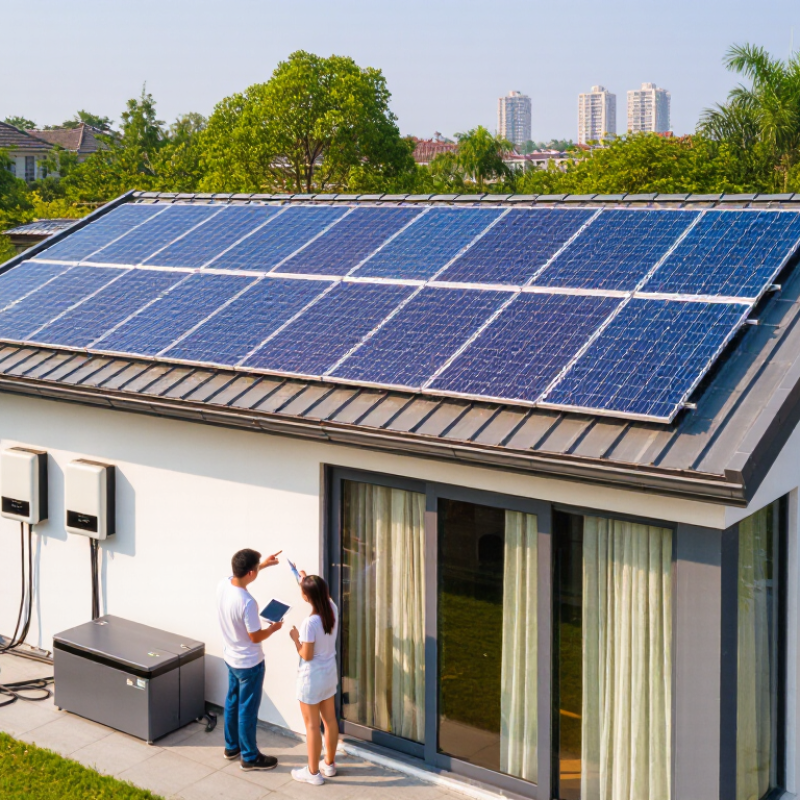
China’s distributed solar market added 96.29 GW in 2023, according to the National Energy Administration’s 2023 power industry statistics. That was about 44% of China’s 216.88 GW of newly installed solar capacity. A remarkable year. The figures show rooftop generation expanding across homes and businesses. Yet capacity growth alone cannot tell a household what it will save. Roof direction, afternoon shade, structural condition, and local grid arrangements all affect a system’s value.
IEA PVPS’s Trends in Photovoltaic Applications 2024 offers wider context. It identifies China as the leading force in global photovoltaic deployment. For homeowners, the practical choice starts with hourly electricity use, not the largest panel count. A south-facing roof may produce strongly at noon, while a family uses most power after sunset. Batteries can shift some energy, but add cost and need careful sizing. Ask for an estimate based on roof shading, local weather, and actual electricity bills. I would treat 96.29 GW as evidence of market momentum, not a promise of quick payback. That distinction is easy to miss.
Choose a Home System: Grid-Tied, Hybrid, or Off-Grid
A grid-tied system suits homes with reliable utility service and daytime electricity use.
Panels feed household loads, while the grid supplies power after sunset. Without a battery, most systems stop operating during an outage for safety. Check your utility’s export rules and compare them with your actual bills before sizing the array. IEA PVPS’s Trends in Photovoltaic Applications 2024 estimates that global solar installations reached about 456 GW in 2023.
Solar is growing fast. That figure shows the technology’s scale, not which setup fits your roof.
A hybrid system pairs solar panels with a battery, keeping selected circuits running during outages.
A fridge, lights, and a router are more realistic backup loads than an entire house. NREL’s 2024 Annual Technology Baseline models battery round-trip efficiency at about 85%; real residential performance varies with equipment and conditions. Off-grid systems suit remote homes without practical grid access, but need careful sizing for cloudy stretches and winter demand. Batteries, a backup generator, and spare capacity add cost. Keep it simple. Walk through a typical evening: note what must stay on, then estimate how many hours it needs power. Roof shade, seasonal sunlight, and battery replacement plans can change the numbers. Plans look tidy on paper; household habits rarely do.
Size the Array: Compare 400–600 W Modules and Local Solar Resources
A home array should be sized against local sunlight, not module wattage alone. A 400–600 W panel describes its rated output under test conditions; roof direction, shade, temperature, and seasonal weather shape real production. NREL’s PVWatts calculator models location-specific weather and uses a 14% default system-loss assumption. That is a modeling default, not a promise for any roof.
For a rough illustration, ten 450 W modules make a 4.5 kW array. At four peak-sun hours daily, it would produce about 18 kWh before losses, or roughly 15.5 kWh using NREL’s default. Peak-sun hours are an energy measure, not simply hours of daylight. In the United States, EIA reports average residential electricity use of 10,791 kWh in 2022, about 29.6 kWh daily; household needs vary widely. Check a local solar-resource estimate and recent utility bills before choosing a system size. A nearby tree can change the result. And estimates miss things. Seasonal shade and roof constraints deserve a second look.
Select Inverters and Batteries: Match Efficiency, Storage, and Backup Needs
China Best Solar Electric Systems for Home Use
Select Inverters and Batteries: Match Efficiency, Storage, and Backup Needs
Choosing an inverter and battery starts with the devices you need during an outage, not the biggest system available. List essentials such as a refrigerator, lights, router, and medical equipment. Check each appliance’s running watts and startup surge; motors can briefly draw more power. Then estimate daily use. Small details matter. Compare usable battery capacity, not just the advertised total, and make sure the inverter can handle both continuous loads and short surges.
Tips: Add up essential loads before choosing equipment. Leave room for conversion losses and unexpected use. Check inverter efficiency across typical loads, not only its peak rating. Review battery cycle life and operating-temperature limits, too.
A larger battery can provide longer backup, but it may add cost without solving an undersized inverter. A common planning mistake is assuming every circuit must stay on during an outage. Decide what can be switched off, and test that plan against a realistic evening: refrigerator running, several lights on, and the router active. Solar production also changes with weather and roof shading, so avoid treating one sunny day as a guarantee. The right balance depends on actual usage, backup priorities, and space for equipment. Even careful estimates can miss a habit or two.
China Best Solar Electric Systems for Home Use — Select Inverters and Batteries
Match inverter efficiency, battery storage, and backup needs.
Estimated battery backup runtime for typical average critical loads. Estimates assume 90% battery-to-AC conversion efficiency; actual runtime varies with system losses, battery settings, and load patterns. Choose an inverter with enough continuous output for the loads running together, and check surge requirements separately.
Check Safety and Quality: IEC 61215 and IEC 61730 Standards
For a home solar system, panel safety starts with checking the standards behind the product.
IEC 61215 covers design qualification and testing of photovoltaic modules. Tests examine performance under conditions such as heat, humidity, and mechanical load. A panel may sit in full sun through hot afternoons, so these checks matter.
Not a full-system test.
IEC 61730 focuses on module safety.
It assesses construction and electrical hazards, including insulation and fire-related risks. Ask for documentation matching the exact module model, not just a similar product from the same product line. Check the certificate issuer, standard edition, and report details.
Small differences matter.
These standards apply to modules, not every part of a home solar installation. They do not confirm that wiring, mounting, or an inverter is suitable for a particular roof. Compare documents with the product label, and ask a qualified installer about local requirements. Paperwork can look convincing, and it is easy to misread.
That deserves a second look.